
If you catch yourself answering “How are you?” with “I’m so busy! all the time, you’re definitely not alone. In many workplaces, being constantly on-the-go has become the norm, almost a status symbol. But the truth is, busyness doesn’t always equal results. In fact, good leadership is more about getting meaningful things done, not just being constantly active. Leaders who stay stuck in this rut often end up feeling overwhelmed, constantly playing catch-up, and on the path to burnout.
Effective leadership isn’t about doing more stuff. It’s about doing the things that really matter. The essential leadership qualities and behaviours that drive real impact are things like being able to communicate genuinely, build trust, and show self-awareness.
To make the switch from stuck in the grind to effective leadership, you need to figure out why we get so hung up on being busy in the first place. It starts by understanding that leadership is all about making meaningful change, acknowledging the costs of being busy, and learning to make time for the thinking and connection that really propels you, and your team, forward.
Why Being Busy Seems Like a Good Idea (But Normally Isn’t)
Being busy creates a pretty convincing illusion. When your calendar is full, and your inbox is a jumbled mess, it can feel like you’re productive. The more you’re moving, the more you feel like you’re getting things done. In some workplaces, that’s the kind of culture that’s expected – “I’m so busy” is seen as the standard and expected response.
But when you look at the numbers, a different picture emerges. Studies after study show that around half of employees are struggling with burnout or feel like they don’t have the time to do their jobs properly. Recent research suggests that around half of employees are contending with burnout or feel they don’t have adequate time and focus to do their core work well. Constant busyness actually:
- Reduces the space you have in your mind for focusing on what really matters;
- Makes you less engaged; and
- Makes it harder to make strategic decisions.
“If everything’s an emergency, nothing is.”
As a leader, that creates a bit of a problem, your team picks up cues from you. If you’re running around going a mile a minute all the time, you’re inadvertently telling your team that they need to be in a state of constant agitation, even if there’s no actual need to be.
The Real Cost: How Burnout Sneaks Up on Leaders
You don’t become burnt out overnight. It’s usually the result of days stretching into weeks, weeks turning into months, with constant deadlines, meetings on top of meetings, and no time to catch your breath, and an expectation that you’re always on the go. For leaders who are at the intersection of big picture thinking and day-to-day delivery, the risk is particularly high.
The warning signs are usually pretty clear:
- Decision fatigue, where even the smallest choices feel like a major effort;
- Trouble concentrating on tricky problems;
- Irritability with your colleagues and direct reports;
- Less and less motivation for the work that used to mean something; and/or
- The nagging feeling that no matter how hard you work, you’re still getting nowhere
Those aren’t signs of you being incompetent – that’s your capacity running on empty. And when your capacity’s depleted, your effectiveness suffers, and so does your team’s.
“Taking a good, hard look at how you’re feeling and what you’re doing can help you catch burnout before it catches you.”
What Effective Leadership Actually Looks Like
Effective leadership works differently. Rather than constantly reacting to the latest crisis, effective leaders create space to focus on the things that really make a difference. They’re not about working less hours or delivering less work, they’re about working more intentionally. Leadership qualities like trust, transparency, stability and compassion are what set the truly effective leaders apart.
Three things distinguish effective leaders from those who are just running around like headless chickens all the time:
- Clarity on what’s really important;
- The discipline to make time for thinking; and
- The ability to pass on responsibility to others, rather than hoarding it all to yourself.
Effective communication is a key part of these three elements – it helps you get clarity, communicate where you need to spend your time to add the most value, and gets your team on the same page.
“Learning to be a good leader is a continuous process – it needs continuous learning and self-improvement to help you develop the essential qualities and capabilities you need to make a real impact.”
Clarity on What Really Matters
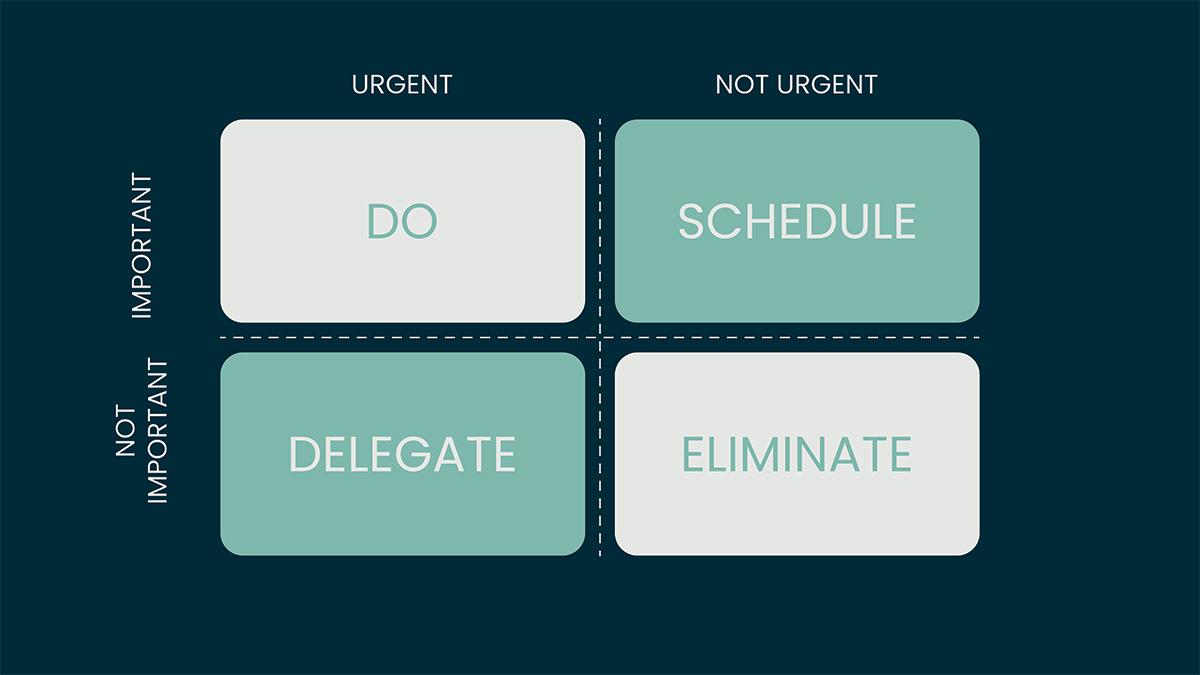 Before you can make good choices on what’s really important, you need to be clear on what you want to achieve. That means setting goals and making sure everyone on your team knows what they’re working towards. The Eisenhower Matrix is a good tool for this – it helps you categorise tasks into four groups:
- Urgent and important: Do these now
- Important but not urgent: Schedule dedicated time
- Urgent but not important: Delegate where possible
- Neither urgent nor important: Eliminate
The important bit to keep in mind is that most of the time, the high-impact stuff – the stuff that really moves the needle – falls into that “important but not urgent” category. Without some deliberate effort, that stuff tends to get pushed out by the things that are just the loudest.
Making Time for Thinking – Set (and Protect Boundaries)
Effective leaders know that just because something needs a response, it doesn’t need to get one right now. They take time to think through the tough stuff, and that helps them make better decisions and communicate more clearly.
That often means slowing down to speed up. A leader who takes the time to think a decision through thoroughly will often do better than one who dashes off a bunch of quick decisions in the same amount of time. Quality of thought matters more than speed of response. Making time for thinking directly helps you to make better decisions and take a more strategic approach to your work.
Empower Your People by Sharing the Load
Delegation is often pigeonholed as just dumping work on your team, when in reality it’s about growing your people and freeing yourself up to focus on the really important stuff.
Effective delegation is about matching the right team member with the right job, based on their strengths and how they like to communicate. When you do it right, you’re investing in your people’s growth and development, while also giving yourself some space to focus on your own priorities.
But it’s not just about handing off work – delegation requires trust, and trust only happens when you’re clear about what you expect, what kind of support you can offer and where it’s okay for people to take risks and learn from their mistakes.
Lots of leaders struggle with delegation because they get caught up in being the bottleneck for all their team’s decisions – they get so busy trying to decide everything themselves that they forget that their team could, in fact, handle a lot of it.
“When done right, delegation means you’re getting the right skills into play, making your team feel more engaged and excited about their work, and ultimately, achieving way better results.”
From Busy to Effective – Making the Shift
Moving from being a slave to your to-do list to becoming a genuinely effective leader isn’t a one-time lightbulb moment, it’s an ongoing journey that requires you to be aware of your own thoughts and patterns, and to set some proper boundaries.
Start by getting to know your own habits and defaults. When are you most likely to get sucked into being busy, and what would change if you started measuring your success by what you get done, rather than just by how many hours you put in? This shift not only gets you better results, but it also helps you develop into a more capable, self-motivated leader.
Next, try a few small experiments. Set aside an hour this week to think big picture and defend it. Find one task that you could hand off to someone on your team to help them grow, and do it. Notice what happens when you slow down and think before you leap, rather than just reacting out of habit.
Being busy might feel familiar, but it isn’t sustainable to remain busy without being effective. To make this shift, you need to focus on getting results, set some clear boundaries, and make time for strategic thinking – when you do, you’ll find yourself becoming a much more effective leader, and getting way more out of your team in the process. It’s all about creating space for clarity, connection and real results that actually make a difference.
Keen to learn more or have a chat about Leadership, Energy Management or Delegation? We’re here to help, contact us for an initial consultation.