If you’ve sat in a succession planning meeting in the last twenty years, chances are you’ve seen a 9-box grid on the screen. Nine squares, two axes, a room full of managers debating who counts as “high potential.” It’s familiar. It’s tidy. And for a lot of organisations, it’s starting to show its age.
I want to spend some time here on what’s replacing it, and more importantly, what actually suits your organisation. Because the honest answer isn’t “throw out the grid and use this instead.” It’s “know what your organisation can handle first, then choose your tool.”
A quick refresher: what is the 9-box grid?
The 9-box grid plots people on two axes: current performance and future potential. Nine boxes come out of that, from “low performer, low potential” through to “high performer, high potential,” often nicknamed things like Star, Enigma or Workhorse. Managers place employees in a box, usually once a year, and those placements feed decisions on promotions, development investment and succession pipelines.
It’s been around since the 1970s, and it earned its popularity honestly. It’s visual, it’s quick and it gives leadership teams a shared language for a genuinely hard question: who’s ready for what’s next?
Where it starts to strain
The cracks in the 9-box grid aren’t a secret. Gallup’s research into CHROs found only 3% strongly agree their organisation is excellent at identifying the right people for management roles, and while 64% still use the grid for succession decisions, only 9% strongly agree it actually works. That’s a big gap between habit and confidence.
Three things tend to drive that gap:
It leans hard on one person’s judgement, usually a direct manager, which opens the door to proximity bias. The people who get face time with leadership, or who present confidently, often get read as “high potential,” while quieter, steady contributors sit in the middle boxes indefinitely. Research by Alan Benson, Danielle Li and Kelly Shue, published as “‘Potential’ and the Gender Promotion Gap,” looked at nearly 30,000 management-track employees at a large North American retailer, a company that used the Nine Box system itself. Women scored higher than men on performance, but were rated 8.3% lower on potential, and were 14% less likely to be promoted. The researchers found those potential ratings explained up to half the overall promotion gap. Even when women outperformed their stated potential, managers didn’t revise their ratings upward the following year. That’s not a small data point. It’s a pattern worth taking seriously.
It’s also a once-a-year snapshot of something that doesn’t move in yearly increments. Skills, motivation and readiness shift constantly. A grid completed in March can be out of date by August.
And the labels stick. Once someone’s filed as an “Enigma” or a “Workhorse,” that framing tends to follow them into the next review, whether or not it’s still true.
“64% of CHROs still use the 9-box grid for succession decisions. Only 9% strongly agree it actually works.”
So what are the alternatives?
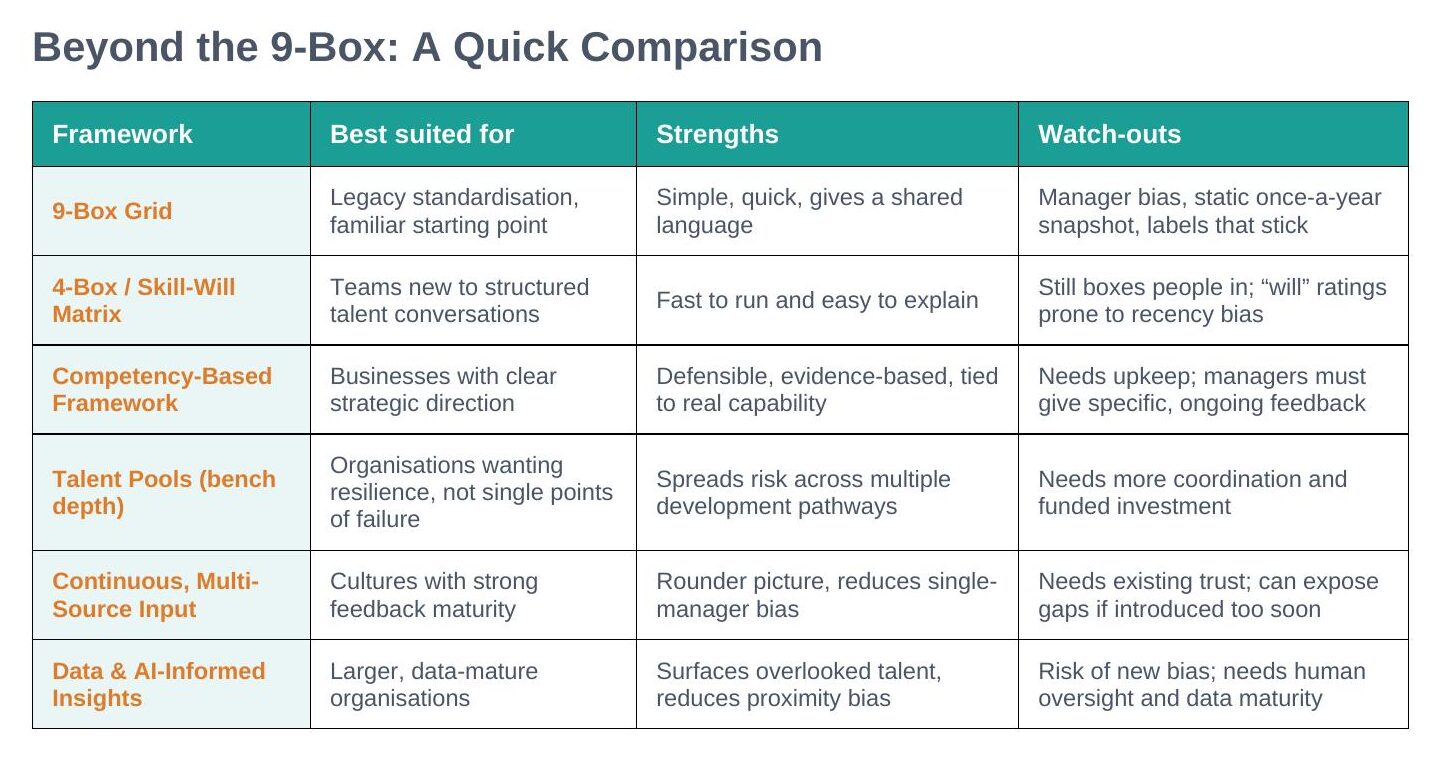
There’s no shortage of frameworks stepping in to fill the gap. Here’s where I’d start looking, and what to weigh up before you commit to any of them.
| Framework | Best suited for | Strengths | Watch-outs |
|---|---|---|---|
| 9-Box Grid | Legacy standardisation, familiar starting point | Simple, quick, gives a shared language | Manager bias, static once-a-year snapshot, labels that stick |
| 4-Box / Skill-Will Matrix | Teams new to structured talent conversations | Fast to run and easy to explain | Still boxes people in; “will” ratings prone to recency bias |
| Competency-Based Framework | Businesses with clear strategic direction | Defensible, evidence-based, tied to real capability | Needs upkeep; managers must give specific, ongoing feedback |
| Talent Pools (bench depth) | Organisations wanting resilience, not single points of failure | Spreads risk across multiple development pathways | Needs more coordination and funded investment |
| Continuous, Multi-Source Input | Cultures with strong feedback maturity | Rounder picture, reduces single-manager bias | Needs existing trust; can expose gaps if introduced too soon |
| Data & AI-Informed Insights | Larger, data-mature organisations | Surfaces overlooked talent, reduces proximity bias | Risk of new bias; needs human oversight and data maturity |
Simplified matrices (4-box grids, Skill-Will matrices)
These strip the 9-box back to something more workable, usually plotting skill against motivation rather than the vaguer “potential.” They’re a reasonable entry point if your organisation is new to structured talent conversations. They’re quick to run and easy to explain. The catch is that they still sort people into fixed categories based on one manager’s read, and “will” or motivation ratings are especially vulnerable to recency bias. A tough quarter can easily be mistaken for low drive. If your managers aren’t yet skilled at separating a bad month from a genuine pattern, this approach can do as much harm as the original grid.
Competency-based frameworks
Rather than rating people against loose ideas of performance and potential, competency models define the specific skills, knowledge and behaviours a role or level actually requires, and assess people against that. SHRM uses this approach for its own certification standards, built around nine behavioural competencies and one technical competency, precisely because it gives a clearer, more defensible picture than a two-axis guess. This works well when your business has clarity about where it’s heading and what capability that requires. It asks more of your managers though. Rating someone against defined behaviours means being specific about evidence, not vibes, which takes a level of comfort with direct, ongoing feedback that not every team has built yet. Structured diagnostic tools can help here, giving managers objective input rather than relying on impression alone.
Talent pools over single successors
A growing number of organisations are moving away from naming one backup per critical role, and building a broader bench instead. McDonald’s famously ran a “one ready now, one ready future” rule for every critical position, which is part of why the business weathered the sudden loss of two CEOs within a year without losing its footing. This approach builds real resilience and spreads development investment across more people. It also takes more coordination and a genuine, funded commitment to developing several people at once rather than grooming a favourite.
Forward-looking succession, not legacy cloning
Worth calling out on its own: the strongest succession decisions look at where the business needs to go, not who most resembles the outgoing leader. Microsoft didn’t hand the CEO role to someone who looked like Bill Gates or Steve Ballmer. Satya Nadella came from the Cloud and Enterprise division because the board had already decided the company’s future depended on that pivot. Apple’s board backed Tim Cook’s operational strength over another creative visionary, because scaling operations was what the next chapter required. This is less a framework and more a discipline: ask what the role will need to deliver in three years, not who currently reminds you of the person leaving.
Continuous, multi-source input
Instead of one manager’s annual rating, this approach pulls in self-assessment, peer feedback and ongoing check-ins throughout the year, giving a rounder and more current picture. It’s a genuinely fairer method on paper. In practice, it only works where there’s already real trust in the room. Asking peers to weigh in on each other’s potential, and doing it continuously rather than once a year, requires a level of openness in your teams that takes time to build. Roll this out in a culture still getting used to honest feedback, and you risk creating more anxiety than clarity.
Data and AI-informed insights
Newer platforms now layer analytics over performance and engagement data to flag potential and flight risk earlier. Used well, this can surface people who’d otherwise be overlooked, particularly quieter contributors who don’t have a loud advocate in the room. Used badly, it just launders old biases through a new interface and adds a layer most teams aren’t yet equipped to interpret or challenge. This suits larger, data-mature organisations more than smaller ones still building out basic people data.
The real question isn’t which framework. It’s which one you can actually run.
Every one of these approaches asks something of your organisation’s culture before it asks anything of a spreadsheet. Continuous, multi-source approaches need people who are genuinely comfortable giving each other direct feedback. Competency frameworks need managers who can talk in specifics, not impressions. Talent pools need a business confident enough in its own future to invest in more than one person at a time.
“Every one of these approaches asks something of your organisation’s culture before it asks anything of a spreadsheet.”
If honest, ongoing feedback conversations still feel awkward in your organisation, jumping straight to a continuous 360-degree model probably won’t fix that. It’ll just surface the discomfort faster. In that case, a competency framework or a well-run 4-box process, paired with real coaching for your managers on how to have these conversations, might get you further than a flashier tool.
In our work with organisations across Newcastle and Sydney, the gap is rarely the framework itself. It’s whether the culture underneath it can carry the conversations the framework depends on.
The 9-box grid isn’t the enemy here. It’s a blunt instrument that was never built for how quickly today’s roles and skills shift. The fix isn’t finding the one true replacement. It’s being honest about where your organisation sits today, and choosing the approach that meets you there, not the one that photographs best in a leadership deck.
If you’re weighing up how to approach succession planning in your organisation, or want to build the manager capability these frameworks depend on, get in touch. We work with organisations on the leadership and culture foundations that make any talent framework work in practice.
Stacey Kelly is Director at Seed People Consulting, a boutique organisational development consultancy based in Newcastle, Australia. Seed People Consulting works with leaders and organisations on leadership, team effectiveness, and culture.